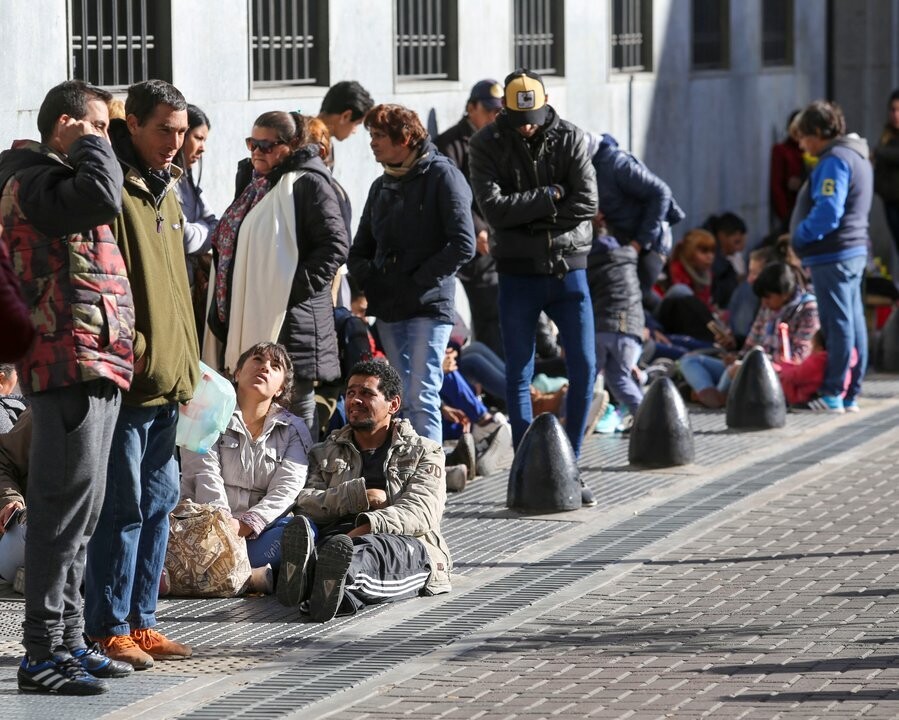
Buenos Aires, Dec 14 (NA) — Unemployment in Buenos Aires during the third quarter of 2025 affected 107,000 people, 57.8% of whom were women, according to a report from the Buenos Aires City Statistics and Census Institute (IDECBA).
The number of people without a job in the Autonomous City of Buenos Aires (CABA) from July to September reached 6.3% of the economically active population (EAP), the same rate as in the same period last year, according to the report accessed by the Argentine News Agency.
Compared to the second quarter of the year, the unemployment rate fell by 1.4 percentage points from the 132,000 citizens without work (7.7% of the EAP) recorded during that period and in the first three months of 2025.
The overall gross activity and employment rates remained practically stable year-on-year.
The report also noted that “women are more affected by unemployment: their rate rises to 7.4%, while the male rate is 5.2%”. Of those employed, 35.9% had pension deductions. 58.1% of the salaried population was not registered in the social security system.
In terms of specific employment rates, disparities are repeated. Overall, the survey provided that the distribution of the employed population by economic sector is as follows: Services concentrate 73.0% of employment, followed by Commerce with 14.4% of the total, while Industry and construction involve 12.0%.
The underemployment rate, which expresses the portion of the active population working less than 35 hours a week for involuntary reasons and is available to work more hours, is 8.2%, which shows a year-on-year drop of 1.9 percentage points. In this regard, it was pointed out that “the distribution of the underemployed population is concentrated in the non-demanding group, that is, the group of people who do not actively seek an occupation with more hours, as they do not pressure the labor market (56.6%)”.
Regarding occupational categories, the study revealed that “72.6% of the employed population works as a salaried worker” and specified that 72.7% has pension coverage, noting that employers do not make pension deductions for the remaining 27.3%.
Likewise, it exposed that 64.2% of the unemployed population reports their first contact with the labor market before the age of 19 and indicated that “among those who worked as salaried workers, 75.1% lost their job for labor reasons. Another disparity occurs when measured by neighborhoods, as the rate in the South Zone (7.4%) is above the total for the City (6.3%). In this sense, the resident populations in the North and Central Zones of the City have more favorable activity rates (64.6% and 65.0% respectively) and employment rates (60.6% and 61.2%, respectively) than those in the South (57.4% and 53.2%, respectively).
In an analysis by age groups, the lowest activity rates correspond to the extreme categories, as in the segment of the young population up to 24 years inclusive, the activity rate is 27.4% and in the age group of 65 years and more, it is 24.4%.
Situation of the last occupation of those who are unemployed: • 92.8% held a position in the private sector. • 86.1% worked in the service-producing sector. • 75.9% worked in low-qualification positions (unskilled or operational). • 68.8% had less than five years of seniority. In particular, 38.3% did not complete a calendar year. • 84.3% worked as salaried workers.